
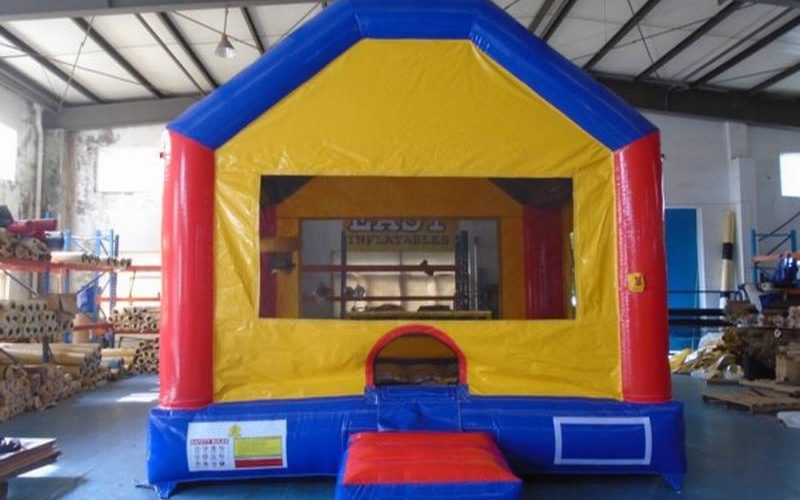
In the Canadian second-hand market, platforms like Kijiji or Facebook Marketplace are flooded with “lightly used” commercial bouncy castles at tempting prices. However, many of these units are “refurbished”—meaning they’ve been cosmetically patched up to hide structural fatigue or safety hazards.
If you are looking to invest in a used unit, use these five “detective” techniques to see through a professional refurbishing job.
1. The “Secondary Needle Hole” Test
Refurbishers often replace worn-out jumping surfaces or slide covers. While this sounds good, it often weakens the original fabric.
- The Detection: Inspect high-stress areas like the base of columns or the entrance step. Look for tiny, empty needle holes near the current seams.
- The Risk: This indicates the PVC has been “re-stitched.” Each old hole acts like a perforation on a piece of paper, making the fabric much more likely to tear under the weight of several children.
2. The “Paint & Scent” Inspection
To hide sun-fading or deep stains, some sellers use specialized vinyl sprays or paints to make the colors pop again.
- The Detection: Get close and smell the colorful printed areas. Original heat-transfer printing is nearly odorless. A refurbished unit will often have a faint, lingering chemical or “spray paint” smell.
- The Touch: Run your hand over the graphics. If the surface feels sticky, gritty, or unusually stiff compared to the rest of the unit, it’s likely a cheap re-paint that will flake off within a few uses.
3. Velcro Fatigue vs. Fabric Condition
The Velcro (hook-and-loop fasteners) on slides and covers is the hardest part to fake.
- The Detection: If the PVC fabric looks suspiciously shiny and new, but the Velcro is frayed, filled with grass debris, or has lost its “grip” strength, you are looking at a “masked” unit.
- The Verdict: Shiny fabric paired with exhausted Velcro usually means the unit has been professionally deep-cleaned or chemically treated to hide hundreds of hours of rental use.
4. The “Internal Air-Tube” Residue
While the exterior can be scrubbed clean, the internal air chambers tell the true story of the unit’s history.
- The Detection: Reach your hand inside the inflation tube (where the blower attaches). Feel the inner lining. If it feels greasy, slimy, or has black soot-like residue, the unit has likely been operated in poor environments or stored wet.
- The Health Risk: Internal mold is a major liability. Once inflated, mold spores circulate directly into the jumping area—a nightmare for safety-conscious Canadian parents.
5. Mismatched Material Density
Commercial-grade units must be 0.55mm (18oz) PVC. Refurbishers sometimes patch holes using thinner, cheaper 10oz or 12oz vinyl.
- The Detection: Pinch the fabric in different areas. If the patches feel noticeably thinner or more flexible than the original body, the structural integrity is compromised.
- The Standard: Always check for the manufacturer’s original warning label. If it’s missing or torn off, the seller is likely hiding the unit’s age or its non-compliance with safety standards like EN14960.
Conclusion: Is the “Deal” Worth the Risk?
A refurbished bouncy castle is a ticking time bomb for your business or family safety. While the price tag might be 40% lower than a new unit, the lack of a warranty and the high risk of a “blow-out” during an event can cost you far more in the long run.
When it comes to inflatables, transparency is everything. If a deal looks too good to be true, it’s usually because the history of the unit is being hidden behind a fresh coat of cleaner and a few strategic patches.